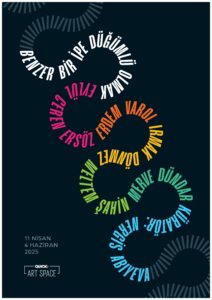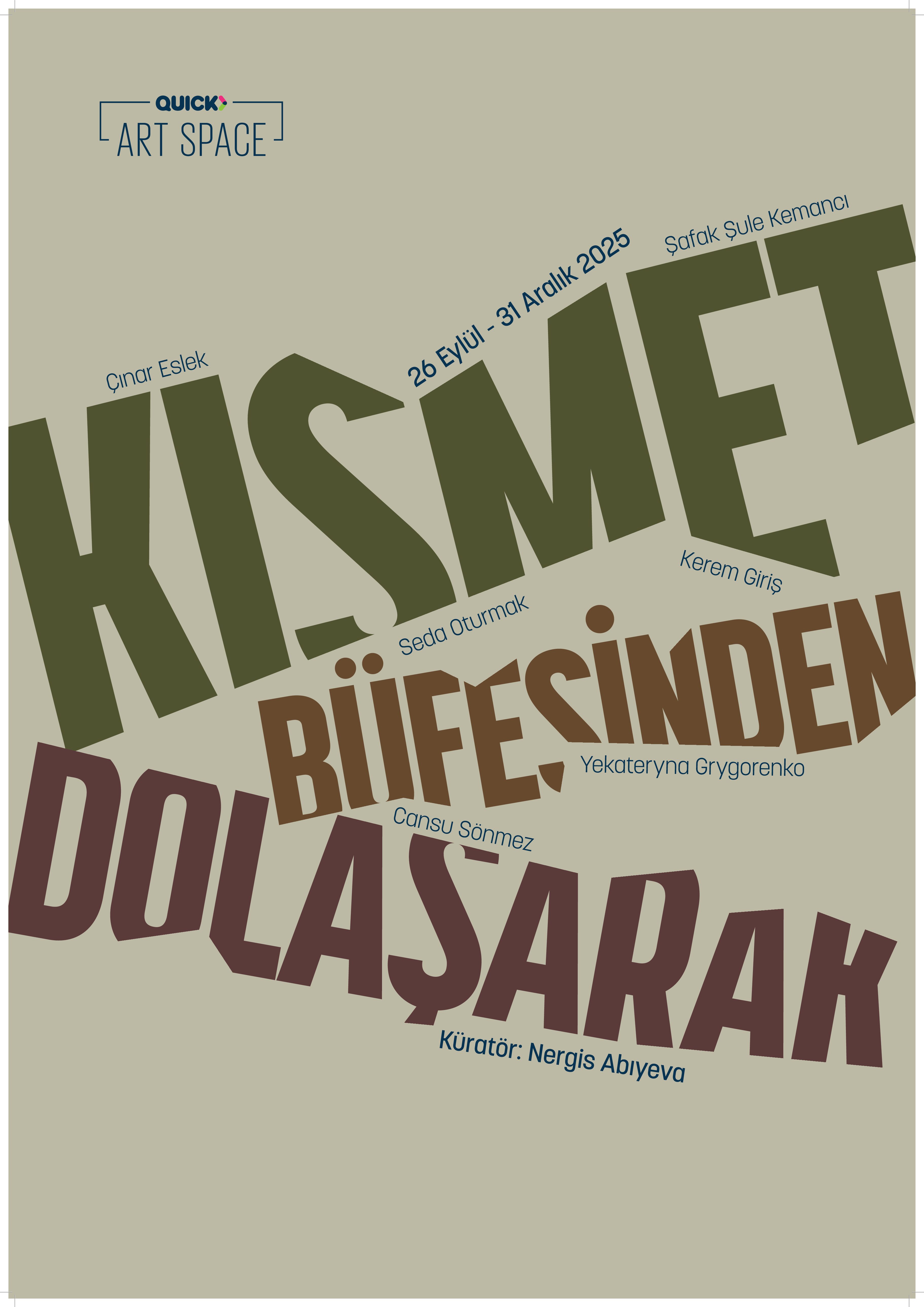
Taking its cue from the writing of Bilge Karasu, "Wandering Through the Kiosk of Kismet" explores, through six artists, the tension between conscious choice and chance in the creative process. The exhibition proposes a route through material relationships, intuition and the unexpected.
Wandering Through the Kiosk of Kismet
“We read because books give us a unique pleasure, one that films, television, etc. cannot provide. Books offer us certain freedoms: while reading, we are free to be mentally active; we participate fully in the creation (the imagining) of a narrative.”1
As an endless source of Turkish literature, the writing of Bilge Karasu was also a reference point for Quick Art Space’s first group exhibition, “Constructed Nature”. Taking its departure from Karasu’s words on “real or fictional images,” his bookKısmet Büfesibrings together texts that rely on visual qualities and proposes a narrative oscillating between the visual and the intellectual. With this exhibition, we wanted to construct a curatorial framework reminiscent of the winding paths in Karasu’s texts.
How much control do artists hold in the process of production? At what point do they leave things to uncertainty, coincidence, or “kismet”? The exhibition “Wandering Through the Kiosk of Kismet” focuses on various moments of the creative process—from the ways artists relate to materials, to intellectual directions and intuitive decisions—on the dynamics that determine the final form of the work. It seeks to draw attention to a creation process that wanders the boundary between conscious choice and the unexpected. The works in the exhibition pursue what is left unsaid, what finds expression visually, and meanings that expand through the power of association. “Wandering Through the Kiosk of Kismet” proposes a route with diverse stops: a route searching for multiple ways of relating to time, space, memory, identity, and gaze.
Çınar Eslek, in her single-piece work “Response to the Apocalypse”, transforms the memory of fabric found on the street and attributes to it a kind of “body.” The accompanying poem serves as the soul, memory, or inner voice inscribed into this body. “Seven legs” evoke non-normative existences; the “vulva” recalls both the beginning and the wound, as well as the cycle lingering at the threshold between apocalypse and rebirth. The stitches hold together not only the fabric but also the narrative and the body. Thus, the viewer bears witness at once to a body and its story, to a text and a surface.
In “The Gift”, Seda Oturmak starts from the idea that gender distinctions are convenient for a male-dominated world. She satirizes the rewarding of boys after circumcision ceremonies. In her paintings, Oturmak deliberately employs a certain nostalgic mise-en-scène, specifically choosing details belonging to the lower-middle socio-economic class. In an ornate circumcision room, the boys are depicted together with the adventurous, competitive, fearless, enterprising, and entertainment-oriented toys gifted to them, as well as with an adult man. The man holding one of the boys on his lap refers to the possibility of toys becoming instruments of exploitation.
Kerem Giriş, in “Köpek Yalasa Doyar” (a phrase Turkish mothers say to children who got dirty playing outside), visualizes play as a childhood space of free contamination. The basket, once a sign of neighborhood sociality and solidarity in everyday life, has over time been replaced by couriers, gated communities, and sterile spaces. With the mirror and the inscription “köpek yalasa doyar” (the literal translation: a dog would get full just by licking), the viewer is invited into a class-based questioning. The basket hanging in the gallery space summons the dust and noise of the neighborhood. Thus, without lapsing into nostalgia, the work oscillates between past and present, clean and dirty, play and discipline, noise and silence.
The kinetic installation “Laleli Belkıs İçeriye Gir Kız” (a Turkish rhyme that children chant while playing jump rope) transforms the joyful childhood game of skipping rope into a mechanical, humanless mechanism, evoking both memory and a game culture lost over time. The rope, turning tirelessly and endlessly by a motor, no longer represents the game but its absence. The persistent loop has taken the place of children waiting their turn to step inside. As the movement continues, what spreads through the space is no longer play itself but the trace left by the lack of play.
“Amber of the Sun”, the first chapter of Yekaterina Grygorenko’s project “Remnants of a Timeless World”, is nourished by dreams, the collective unconscious, and post-human thought. Drawing on Donna Haraway’s approach to speculative fabulation, it opens a space of imagination where past, future, and never-lived possibilities intertwine. Amber sun is the fossil remnant of a history that never existed; rather than fixing time, it fragments it, bringing memory to light. The motion inscribed in the hybrid body’s torso questions the reduction of life to mere biological vitality, implying that the true source of existence lies in remembering, leaving traces, and intensifying within memory. The boundaries between organic and technological, living and non-living, human and non-human become permeable and interwoven.
In her site-specific installation for Quick Art Space, Şafak Şule Kemancı makes visible both her personal relationship with materials and the interaction among those materials. On her first visit to Quick Tower, Kemancı was struck by the large glass facades of the space and worked with a gauzy fabric that created a permeable perception between interior and exterior. On this fabric, she formed an organic shape resembling an orchid at first glance. The vegetal forms that have become the artist’s signature reappear in this work as well—familiar yet open to surprise; with its nature-like but not fully definable structure, it invites the viewer to rethink the boundaries of form.
In her installation “Cynara”, Cansu Sönmez examines the multilayered history of Bayrampaşa, where she spent her childhood and adolescence, through the axis of the artichoke plant. The work is based on a multilayered methodology of “performative research,” encompassing field studies, historical archive scans, gastronomy and mythology studies, and AI productions. Hybrid forms made of bronze, polyester, ceramic, 3D printing, and upcycled materials situate themselves between organic, architectural, and cyborg aesthetics, making visible the permeability between utopia and dystopia. Through its speculative narrative extending from the past to a futuristic “green island,” “Cynara” reveals the socio-political processes shaping spatial perception. At the same time, it is an installation that invites us to think together about the possible futures of ecosystems.
Nergis Abıyeva, Erenköy, 2025.